 For many children, the most intimidating parts of dental treatment are not necessarily the treatment itself. The anticipation of a needle, the sound and vibration of a traditional dental drill, and the lingering numbness associated with local anesthesia can all contribute to dental anxiety.
At the pediatric dental office of Gary D. Sabbadini, D.D.S. in Pinole, California, we believe technology should help make dentistry more comfortable, efficient, and child-friendly. That is why our office offers Solea laser dentistry, an advanced all-tissue dental laser that can allow many procedures to be performed with little or no local anesthesia.
Our practice reports that the majority of its hard- and soft-tissue procedures performed with Solea require virtually no anesthesia, while soft-tissue procedures can also be completed with virtually no bleeding.
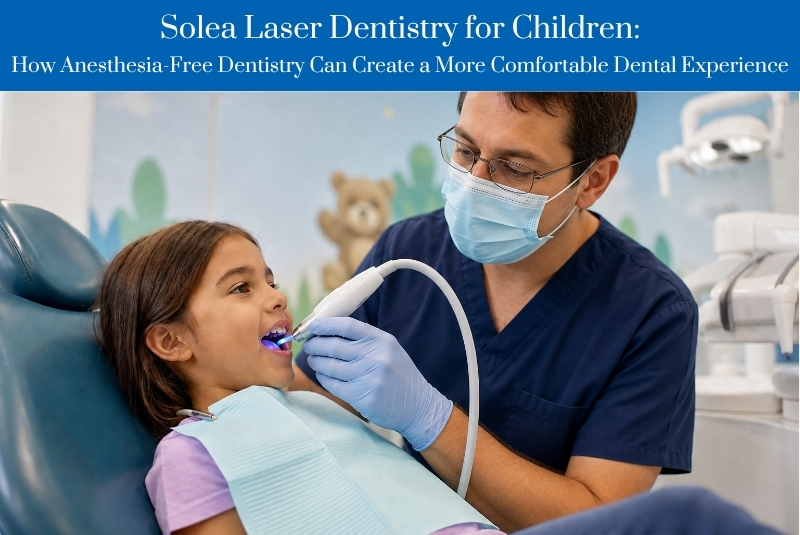
For parents searching for anesthesia-free pediatric dentistry in Pinole, CA, Solea represents an important advancement: in appropriate cases, children may be able to receive necessary dental treatment without an injection, without the traditional drill experience, and without leaving the office with a numb lip, cheek, or tongue.
What Is Solea Laser Dentistry?
Solea is an advanced CO₂ all-tissue dental laser designed to work on both hard and soft oral tissues. According to its manufacturer, Solea operates at a 9.3-micron wavelength and can be used on structures ranging from enamel and dentin to gingiva and bone.
This ability to address both teeth and soft tissues distinguishes Solea from technologies designed for more limited dental applications.
For pediatric patients, one of Solea’s most meaningful advantages is its ability to eliminate or substantially reduce the need for injectable local anesthesia during many appropriate procedures. Convergent Dental specifically describes Solea as providing an anesthesia-free experience for many treatments, while emphasizing its applications in pediatric dentistry.
Instead of approaching every dental procedure with a traditional needle-and-drill sequence, Solea gives the dentist another treatment option that may make the experience considerably easier for a child.
How Can Solea Provide Anesthesia-Free Dentistry?
Traditional restorative dentistry frequently requires local anesthetic before a dentist uses a rotary instrument to remove affected tooth structure. The anesthetic prevents pain but usually requires an injection and may leave the mouth numb for some time afterward.
Solea approaches treatment differently.
Its 9.3-micron CO₂ laser wavelength is highly absorbed by hydroxyapatite, an important mineral component of teeth. The technology allows the dentist to precisely treat hard dental tissues as well as soft tissues.
For many appropriate procedures, this means treatment can be completed without an injection of local anesthetic.
At our Pinole pediatric dental practice, the majority of hard- and soft-tissue procedures performed using Solea are completed with virtually no anesthesia.
Every child and every procedure is different, however. Anesthesia-free dentistry cannot be guaranteed for every patient or every treatment. Dr. Sabbadini evaluates the child’s individual needs, the tooth or tissue being treated, the extent of treatment, and other clinical considerations before determining the most appropriate approach.
Why Anesthesia-Free Dentistry Can Be Especially Valuable for Children
Children often experience dentistry differently from adults. Something an adult considers mildly unpleasant can feel overwhelming to a young child who does not understand why it is happening.
Reducing some of the sensory triggers associated with dentistry can therefore make a significant difference.
Less Fear of Dental Needles
Fear of injections is common among pediatric dental patients. A child may become anxious before treatment simply because they expect to receive a shot.
When Solea allows treatment to be completed without injectable local anesthesia, one of the most recognizable sources of dental fear may be removed from the appointment.
Convergent Dental notes that eliminating the needle and traditional drill experience can address two major sources of anxiety among pediatric dental patients.
No Lingering Numbness When Local Anesthesia Is Not Needed
Local anesthesia can remain effective after a dental procedure is finished. While numbness is temporary, it can feel strange to children.
More importantly, a numb lip, cheek, or tongue can sometimes be accidentally bitten or chewed by a child who cannot properly feel the tissue.
When Solea treatment can be performed without local anesthesia, there is no anesthesia-related numbness afterward. Our practice’s information about Solea specifically highlights the benefit of avoiding numbness and the associated concern about children biting their lips, cheeks, or tongues.
Reduced Traditional Drill Experience
Dental drills create recognizable sounds, vibrations, and sensations. Even children who have never undergone restorative treatment may associate those sounds with something frightening.
Solea provides an alternative method of treating many hard-tissue procedures. By reducing or eliminating reliance on the conventional drill for appropriate treatments, we can create a different sensory experience for pediatric patients.
A Quicker Return to Normal Activities
When injectable local anesthesia is unnecessary, children do not have to wait for their mouth to regain normal sensation.
Our practice notes that patients treated appropriately with Solea can return to their day without the lingering numb sensation traditionally associated with local anesthesia.
For busy families, that can make a dental appointment easier to incorporate into school, work, meals, and everyday activities.
Solea and the Goal of Positive Childhood Dental Experiences
Pediatric dentistry is not only about treating today’s cavity. It is also about helping children establish an attitude toward oral healthcare that can influence them throughout adulthood.
A frightening early dental experience can make future appointments more difficult. Conversely, a child who learns that visiting the dentist can be manageable and comfortable may approach future preventive and restorative care with greater confidence.
Solea supports this philosophy by reducing several elements children commonly associate with uncomfortable dentistry.
Convergent Dental’s pediatric information describes Solea’s goal as helping create a generation of patients who are less afraid of dental treatment by reducing reliance on needles and traditional drills.
Technology alone does not determine whether a child has a positive experience. Communication, patience, clinical judgment, and a dental environment designed specifically for children remain essential.
Our Pinole practice combines these principles with modern dental technology to help infants, children, adolescents, and patients with special healthcare needs receive individualized care.
What Pediatric Dental Procedures Can Solea Be Used For?
Because Solea is an all-tissue laser, it has applications involving both teeth and oral soft tissues.
Depending on a child’s individual diagnosis and treatment needs, Solea may be considered for procedures involving cavities and restorative dentistry as well as selected soft-tissue procedures.
Convergent Dental also documents pediatric applications including procedures such as frenectomies and gingivectomies.
The fact that Solea is capable of performing a procedure does not automatically mean it is the best option for every child. The appropriate treatment method should always be determined after a clinical examination.
Is Solea Really Needle-Free?
For many procedures, Solea can significantly reduce or eliminate the need for injectable local anesthesia.
Our office states that the majority of hard- and soft-tissue procedures performed with Solea are completed with virtually no anesthesia.
However, parents should understand the distinction between anesthesia-free dentistry being possible and anesthesia never being necessary.
Some patients or procedures may still require local anesthesia, nitrous oxide, sedation, or another method of managing comfort and anxiety. Pediatric dental care should always be individualized rather than based on a single technology.
Solea Laser Dentistry and Dental Anxiety
Dental anxiety can originate from several sources, including previous experiences, fear of pain, unfamiliar surroundings, sounds, smells, and anticipation of injections.
For children who are particularly concerned about the needle or drill, Solea may remove some of those triggers.
This can have benefits beyond a single appointment. When a child successfully completes dental treatment without experiencing something they feared, the experience may help build confidence for future visits.
Parents also play an important role. Using calm, positive language and avoiding frightening descriptions of dental treatment can help children arrive with fewer preconceived fears.
Does Solea Mean My Child Will Never Need Sedation?
No. Solea and dental sedation serve different purposes.
Solea may reduce the need for local anesthesia during many appropriate procedures and can make treatment easier for some children. However, sedation may still be appropriate when a child has significant anxiety, difficulty cooperating safely, extensive treatment needs, medical or developmental considerations, or other circumstances.
Dr. Sabbadini’s office offers multiple approaches to pediatric dental care, including Solea laser dentistry as well as nitrous oxide, conscious sedation, and in-office IV sedation when clinically appropriate.
The goal is not to use the same approach for every child. It is to select the safest and most appropriate treatment strategy for the individual patient.
Solea Laser Dentistry for Children With Special Healthcare Needs
Children with special healthcare needs may have heightened sensitivity to sound, vibration, unfamiliar sensations, or changes in routine.
Our practice provides pediatric dental care for medically compromised patients and children with special needs, including patients with autism, Down syndrome, cerebral palsy, and developmental delays.
For an appropriate patient, reducing the need for injections, drill noise, and prolonged numbness may help simplify the sensory demands of treatment.
However, every child’s needs are unique. Parents and caregivers should discuss sensory sensitivities, communication needs, previous dental experiences, medical considerations, and behavioral concerns with the dental team so that an individualized treatment plan can be developed.
The Difference Between Local Anesthesia and General Anesthesia
When discussing “anesthesia-free dentistry,” it is helpful for parents to understand that dental anesthesia can refer to different things.
Local anesthesia numbs a specific area of the mouth while the patient remains awake. General anesthesia places a patient into a controlled sleep-like state so necessary dental treatment can be performed.
Solea can reduce or eliminate the need for local injectable anesthesia during many appropriate procedures. It does not mean that every child who might otherwise require sedation or general anesthesia will automatically be able to receive treatment without it.
Our practice explains that general anesthesia may still be beneficial for children with extreme anxiety, difficulty cooperating safely, or extensive treatment needs.
Clinical recommendations are made according to each child’s needs and safety.
Minimally Invasive Pediatric Dentistry in Pinole, CA
Solea is part of a broader movement toward minimally invasive dentistry, in which dentists seek to diagnose disease early, preserve healthy tooth structure whenever possible, and select treatments appropriate to the child’s individual condition.
Our office offers multiple minimally invasive treatment options in addition to Solea, including Silver Diamine Fluoride (SDF), Hall Crown Treatment, SMART Treatment, and Icon treatment.
Not every cavity requires exactly the same solution. Factors such as a child’s age, cavity location and depth, risk of future decay, cooperation level, and overall oral health can influence which treatment is most appropriate.
Why Choose Gary D. Sabbadini, D.D.S. for Pediatric Laser Dentistry in Pinole?
Technology is most valuable when it is combined with appropriate clinical experience and pediatric-specific care.
Dr. Gary Sabbadini is a Board Certified Specialist in Pediatric Dentistry. His professional background includes dental training at the University of the Pacific School of Dentistry and a two-year pediatric dentistry specialty program at Children’s Hospital in Cincinnati, where he served as Chief Resident during his second year.
The practice has served children and families in Pinole and surrounding East Bay communities since 1999 and provides preventive, restorative, emergency, orthodontic, sedation, minimally invasive, and laser dental services for infants, children, adolescents, and patients with special healthcare needs.
Solea adds another important option to that comprehensive approach.
Frequently Asked Questions About Solea and Anesthesia-Free Pediatric Dentistry
What is the Solea dental laser?
Solea is a CO₂ all-tissue dental laser capable of treating hard and soft oral tissues. It operates at a 9.3-micron wavelength and can be used on tissues including enamel, dentin, gingiva, and bone.
Can Solea really provide anesthesia-free dentistry?
Yes, many procedures can be performed without injectable local anesthesia. At Dr. Sabbadini’s practice, the majority of hard- and soft-tissue procedures performed with Solea are completed with virtually no anesthesia. Individual results and treatment requirements vary.
Will my child definitely avoid a dental injection?
Not necessarily. While avoiding injections is possible for many Solea procedures, some treatments or individual patients may still require local anesthesia. Dr. Sabbadini will determine what is appropriate after evaluating your child.
Does Solea completely eliminate pain?
No dental technology should be presented as guaranteeing a completely sensation-free experience for every patient. Solea is designed to enable many procedures to be completed without injectable anesthesia and can substantially change the traditional treatment experience, but individual sensations and treatment needs vary.
Does Solea replace the traditional dental drill?
For many appropriate procedures, Solea can reduce or eliminate the need for conventional rotary instrumentation. Whether it can be used exclusively depends on the specific clinical situation.
Can Solea be used to treat cavities in children?
Yes. Solea has hard-tissue applications and can be used for appropriate restorative procedures involving cavities. Dr. Sabbadini determines whether laser treatment is suitable for each tooth and patient.
Can Solea treat gums as well as teeth?
Yes. Solea is an all-tissue laser with applications involving both hard dental tissues and soft oral tissues. Pediatric applications documented by the manufacturer include soft-tissue procedures such as gingivectomies and frenectomies.
Will my child’s mouth be numb after Solea treatment?
If treatment is completed without local anesthetic, your child will not experience the lingering numbness caused by that anesthetic. This can also eliminate anesthesia-related concerns about accidentally biting a numb lip, cheek, or tongue.
Can my child eat after Solea treatment?
When local anesthesia has not been used, there is no need to wait for anesthesia-related numbness to disappear before safely regaining normal sensation. However, parents should always follow the specific post-treatment instructions provided for their child’s procedure.
Is Solea helpful for children who are afraid of the dentist?
It can be particularly useful for children whose anxiety is associated with needles, drill sounds, vibration, or numbness. Solea’s pediatric applications emphasize reducing these common anxiety triggers.
Can Solea reduce the need for sedation?
For some children and procedures, making treatment easier without an injection or traditional drill may reduce barriers that otherwise make care difficult. However, Solea does not eliminate the need for sedation in every situation. Sedation decisions depend on the child’s medical history, anxiety, cooperation, treatment requirements, and safety considerations.
Is Solea appropriate for children with special healthcare needs?
It may be an excellent option for some patients with special healthcare needs, particularly when reducing sensory triggers could make treatment easier. Suitability must be determined individually. Dr. Sabbadini’s practice provides dental care for children and adolescents with a range of special healthcare needs.
Does Solea work for every dental procedure?
No. Solea has broad hard- and soft-tissue applications, but no single dental technology is appropriate for every condition. A pediatric dentist must diagnose the problem and determine the best treatment approach.
Why might parents prefer anesthesia-free pediatric dentistry?
Avoiding injectable anesthesia may mean less fear surrounding needles, no anesthesia-related numbness afterward, reduced risk of a child biting numb oral tissues, and an easier transition back to normal daily activities.
How do I know whether my child is a candidate for Solea?
The best way to determine candidacy is through a pediatric dental examination. Dr. Sabbadini can evaluate your child’s oral health, treatment needs, medical history, age, and ability to cooperate and explain whether Solea is appropriate.
A Different Kind of Pediatric Dental Experience
Modern pediatric dentistry should do more than repair teeth. It should help children feel safe receiving dental care and give families treatment options that support long-term oral health.
For many patients, Solea laser dentistry offers an alternative to the traditional needle-and-drill experience. By allowing many appropriate hard- and soft-tissue procedures to be completed with little or no injectable anesthesia, Solea can make dental treatment simpler and more comfortable for children and their families.
If your child needs dental treatment and you are interested in Solea laser dentistry or anesthesia-free pediatric dentistry in Pinole, CA, contact the office of Gary D. Sabbadini, D.D.S. to learn whether Solea may be appropriate for your child’s needs.
Contact Information
Gary D. Sabbadini, D.D.S.
Board Certified Specialist in Pediatric Dentistry
1500 Tara Hills Dr., Suite 100
Pinole, CA 94564
Phone: (510) 724-4400
Website: pinolepediatricdentist.com
The practice serves children and families in Pinole and surrounding East Bay communities and offers pediatric preventive, restorative, minimally invasive, laser, orthodontic, emergency, and sedation dentistry.